
Stars are at once the most accessible and essential elements of understanding the night sky. Almost all of the more esoteric objects that astronomers observe and relish are intimately related to the apparently humble star. Galaxies, are composed of billions of individual stars while closer to home, relatively speaking, our own galaxy contains numerous clusters of stars. Some of these are straggly collections of a few dozen to a few hundred stars, the open clusters, while others are dense balls of many thousands of stars, the globular clusters. Vast clouds of glowing gas, the nebulae, are related too: Some are nursery regions where new stars are born, such as the wonderful great Orion nebula, while others are the remnants of huge explosions in which dying stars make their last stand.
In a sense then, stars are the central thesis of astronomy and it is fitting that our exploration of the Bedford Catalogue starts with them. There is another more prosaic reason however; stars are accessible to us all. The only optical device needed is a pair of eyes and even in the cities where the pernicious glow of sodium streetlights invades our sense of the night, the brighter stars are still visible.
The Bedford catalogue contains several hundred stars but many of these are double or triple stars, caught in a perpetual dance with one another by gravity. Most of these are best seen though a telescope but the catalogue also contains some of the brightest and most interesting stars and it is these that this post explores. Table 1 (click the link for a copy) lists the single stars of the Bedford catalogue, some of these are discussed in the original catalogue as doubles but are now known to be single with the apparent duplicity merely being an chance optical effect. This matters not a jot since these stars are without doubt the most celebrated ones in the sky.
Table 1: Bright stars in theBedford Catalogue
This list can be used in several ways; if you are already a seasoned astronomer then I’m sure like me you have overlooked ‘simple’ stars in favour of more celebrated fare and finding some of these using a simple star map is a good way to keep alive the joy of stargazing. This first selection from the Bedford catalogue is however aimed particularly at total beginners who perhaps have occasionally looked up and thought the sky looked nice but haven’t gone further. Many of the listed stars are suitable for observing without any optical aid. Look at the list and select those brighter than magnitude 4 (the lower the magnitude the brighter the star so here the magnitude number will be less than 4). These stars can be seen under most any light even moderately light polluted skies. If you enjoy a darker country sky then you will be able to see stars as faint as magnitude 6 so more of the list is accessible to you.
At the start, finding objects in the sky can seem complex because they are located using an different set of coordinates than terrestrial maps show and because many star names will not be on most maps. Help is at hand.. firstly I describe below how to find some of the brightest stars in the sky to get you started, secondly there are several entirely free software programs available that draw a map of the sky customised for your date and location and which allow you to search for a given star and finally both the Astronomy Now and BBC sky at night magazines website have star map applications on them that you can look at any time to find the brightest stars (http://www.skyatnightmagazine.com/interactive-planetarium and http://www.astronomynow.com/sky_chart.shtml). In terms of the free software I like Cartes Du Ciel (http://www.ap-i.net/skychart/start) but there are several available. You can enter either the star name or SAO number in the search function in the Cartes Du Ciel program to get a customised map of your sky with the star highlighted.
Tonight though lets find one stand out star constellation together : Cassiopeia. This constellation has the advantage that it is circumpolar, jargon to mean that there is not a time of the year when it is below the horizon at night time from mid northern latitudes. This suits our purpose well because whenever you are reading this blog post you can find this constellation in your sky tonight. Cassiopeia forms the really recognisable ‘W’ shape in the sky and easily found with the help of one of the star charts named above. The next figure shows the W asterism as you might see it when looking up at the sky. The orientation and position changes with the seasons but the star charts above will help there.
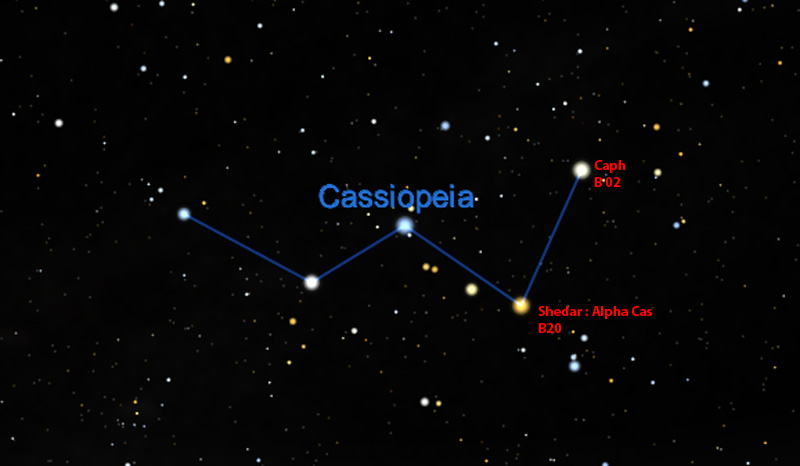 Once you’ve found this constellation, you will also have found your first couple of Bedford objects, the bright stars Alpha and Beta Cassiopeia. The opening paragraph of Smyth’s prose for the brightest of these Shedar, Bedford 20, exemplifies how wonderfully he writes and is as interesting today as it must have been for his original readers:
‘A Nautical Almanac star, with a companion (A magnitude 3, pale rose-tint ; B magnitude 9, smalt blue) . This object is in the right breast of Dhat-al-Kwrsa, the Lady of the Throne ; and it also obtained the names of Lucida Cassiopeia and Sehedir ; the last being probably a corruption of Al-sadr, the breast, by the franxers of the Alphonsine.‘
I very much hope you have enjoyed this initial journey into this wonderful book and even more that you are encouraged to use Smyth’s book to explore the amazing night sky that he so poetically describes. I will return in future posts to explore the Bedford catalogue in more detail but in the meantime the starry heavens are calling and the sky is clear.
 Minimal Star